

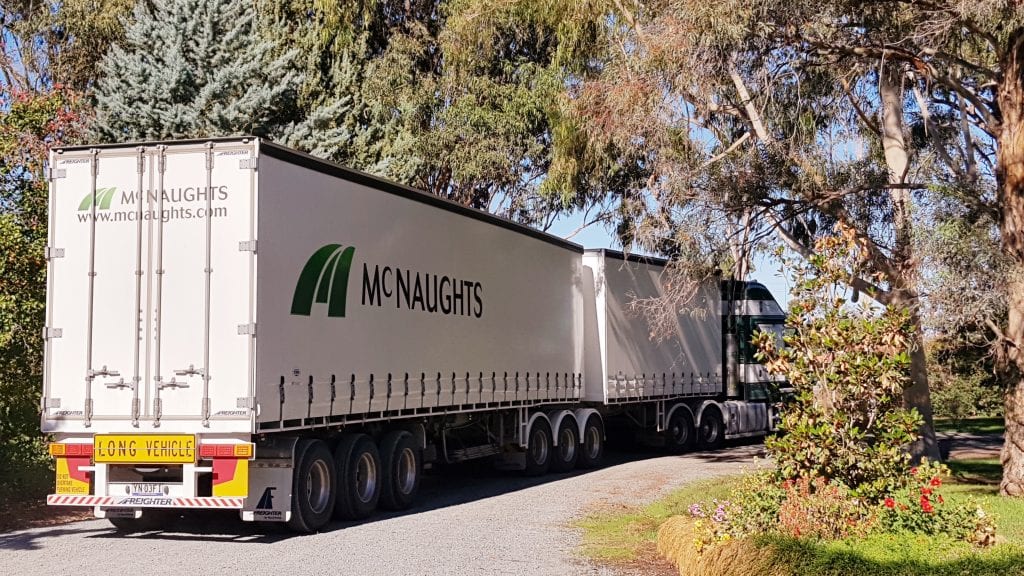
Fertiliser pallet weight limits are not determined by one universal maximum. The safe and legal weight depends on the pallet’s rated capacity, the fertiliser packaging, vehicle configuration, axle and gross mass limits, load distribution and restraint requirements. Before arranging general freight transport for palletised fertiliser, the total weight and dimensions of each pallet should be confirmed so the appropriate vehicle and loading plan can be selected.
Key Takeaways
- There is no single legal weight limit that applies to every fertiliser pallet in Australia.
- The pallet itself must be suitable for the weight of the fertiliser loaded onto it.
- The total loaded pallet weight includes the fertiliser, packaging and pallet.
- Vehicle gross mass and axle mass limits still apply, even when every individual pallet is within its rated capacity.
- Heavy pallets need to be positioned carefully to maintain suitable weight distribution.
- Loads must be restrained so they remain stable during normal transport conditions.
- Fertiliser classification should be confirmed before transport because some products may have additional transport requirements.
- Accurate weights provided before collection make it easier to select appropriate equipment and plan the load.
Is there a maximum weight for a fertiliser pallet?
There is no single Australian maximum that can safely be applied to every fertiliser pallet. Several limits have to be considered at the same time.
First is the pallet’s own rated capacity. Pallets differ in their construction, condition and intended application. A pallet capable of supporting one load in static storage conditions may have a different capacity when it needs to be lifted, moved and transported.
The fertiliser packaging matters as well. Bagged granular fertiliser, for example, needs to be stacked in a way that keeps the pallet stable and avoids placing excessive pressure on individual packages.
Then there is the transport vehicle. A pallet may be within its individual capacity but still contribute to an overloaded vehicle or axle group when combined with the rest of the consignment.
For that reason, fertiliser pallet weight limits should be considered as part of the complete freight plan rather than as an isolated number.
How do you calculate the total weight of a fertiliser pallet?
Start with the net weight of the fertiliser and add the weight of all packaging and the pallet itself. The result is the gross pallet weight that needs to be considered when planning transport.
For example, if multiple bags are stacked on a pallet, simply multiplying the number of bags by the stated net weight only gives you the fertiliser weight. It does not account for the pallet, wrapping or other packaging.
This distinction becomes important when several pallets are transported together. Small differences between estimated and actual pallet weights can accumulate across a full load.
Before booking transport, record the gross weight of each pallet where possible. You should also provide pallet dimensions, quantity and any unusual loading requirements. These details help the transport provider assess whether the freight can be accommodated safely and efficiently.
Where fertiliser is being moved in larger quantities rather than as individual pallets, bulk freight transport may provide a more appropriate solution depending on the product and destination.
Which vehicle weight limits apply when transporting fertiliser pallets?
Australian heavy vehicle requirements consider more than the total amount of freight on the vehicle. Relevant mass requirements can include gross vehicle mass, gross combination mass and mass limits applying to particular axle groups.
This means a truck is not necessarily compliant simply because its overall load appears to be below its total capacity. How the weight is distributed across the vehicle matters.
A concentration of heavy fertiliser pallets in one part of the trailer can place too much mass over an axle group. Loading plans therefore need to consider the individual pallet weights and their position rather than simply fitting as many pallets as possible onto the deck.
The exact limits depend on the vehicle and operating conditions, so businesses should not rely on a generic truck payload figure when planning a fertiliser shipment. The transport operator should assess the relevant vehicle configuration and applicable mass requirements.
This is particularly important for agricultural freight, where products can be dense and individual pallets can represent a significant amount of weight within a relatively small footprint.
Why does pallet condition matter when transporting heavy fertiliser?
Weight capacity is only useful when the pallet is in a condition that allows it to perform as intended.
A pallet that is cracked, damaged, deteriorated or otherwise unsuitable can become unstable during forklift handling or road transport. Heavy bags of fertiliser place substantial loads on the pallet structure, and movement during handling can expose weaknesses that were not immediately obvious while the pallet was sitting still.
Before dispatch, check that pallets are suitable for the product and intended journey. Look for damaged boards or components, significant distortion and other signs that could compromise stability.
Packaging should also be inspected. Torn or poorly secured fertiliser bags can allow product to escape, potentially changing the stability of the pallet and creating additional handling problems.
Taking a few minutes to inspect pallets before loading is far simpler than dealing with damaged freight after it has been placed on the vehicle.
How should fertiliser pallets be loaded and restrained?
A fertiliser pallet should remain stable throughout loading, transit and unloading. Correct placement and restraint help prevent freight from shifting and contributing to vehicle instability or product damage.
Important considerations include:
- confirming individual pallet weights before deciding where they will be positioned
- distributing heavy pallets appropriately across the vehicle
- keeping each pallet stable and correctly orientated
- checking that bags or containers are securely stacked on the pallet
- using appropriate load restraint systems for the freight and vehicle
- avoiding damaged pallets that could fail during handling
- considering how pallets will be accessed and safely unloaded at the destination.
Load restraint is not simply about preventing freight from falling off a vehicle. Freight needs to remain appropriately restrained against the forces that can occur during normal road transport, including braking, acceleration and cornering.
Transport operators and consignors should work from accurate freight information so the appropriate restraint and loading method can be determined before the vehicle leaves the site.
Are all fertilisers treated the same during transport?
No. “Fertiliser” covers a broad range of products, so it is important to identify exactly what is being transported rather than assuming the same requirements apply to every pallet.
Many common agricultural fertilisers can be transported as ordinary freight when appropriately packaged and handled. Other products or formulations may be subject to additional requirements depending on their classification, composition and quantity.
Check the product information and relevant safety documentation before arranging transport. If a fertiliser is classified as dangerous goods, additional obligations may apply to packaging, documentation, segregation, placarding or transport arrangements depending on the circumstances.
Where the product falls within regulated requirements, an experienced dangerous goods transport provider can help ensure the freight is handled using an appropriate transport solution.
The important part is not to guess based on the product’s everyday name. Confirm what the fertiliser is and provide accurate information to the carrier when organising the shipment.
What information should you provide when booking fertiliser pallet transport?
Good freight planning starts before the truck arrives. Providing accurate information allows the carrier to select appropriate equipment, assess vehicle capacity and plan pallet placement.
At a minimum, confirm how many pallets are being moved and provide their gross weights and dimensions. If individual pallet weights vary substantially, identify those differences rather than supplying only an average.
The carrier should also know what type of fertiliser is being transported, how it is packaged and whether there are any applicable product handling requirements.
Collection and delivery conditions matter too. Farm and regional sites can have access restrictions, uneven surfaces or limited loading equipment. A vehicle that works perfectly well at a warehouse may not be suitable for every agricultural property.
Accurate information at the booking stage reduces the chance of discovering on collection day that the freight is heavier, larger or more difficult to handle than expected.
When is pallet transport suitable for fertiliser?
Palletised transport can make sense when fertiliser is supplied in bags or other packaged units and needs to remain organised throughout the freight process. Pallets make forklift handling possible and can simplify counting, loading and unloading individual consignments.
It is not necessarily the right method for every fertiliser movement, though.
Large volumes of loose product may be better suited to another transport configuration. The decision depends on the fertiliser, quantity, packaging, delivery site and how the product will ultimately be handled.
For loose agricultural materials, walking floor transport may be suitable for particular loads and unloading environments. Packaged fertiliser, meanwhile, may be better handled as palletised general freight.
There is also the next stage to think about. Once suitable fertiliser reaches the farm, application needs to be planned around the product and agronomic requirements. McNaughts provides fertiliser spreaders and spreading services for agricultural operations where appropriate.
Who is responsible for keeping fertiliser pallet loads compliant?
Heavy vehicle safety is a shared responsibility across the transport supply chain. Depending on a party’s role and activities, responsibilities can extend beyond the driver or transport company.
That makes accurate communication important. A carrier cannot plan effectively around a pallet described as weighing substantially less than it actually does. Likewise, loading practices can affect axle mass, restraint and vehicle stability even when the correct total freight weight has been supplied.
Businesses involved in consigning, packing, loading or transporting fertiliser should understand the responsibilities relevant to their activities and avoid practices that could encourage or result in unsafe or non-compliant transport.
For specific regulatory requirements, current guidance from the relevant Australian heavy vehicle and road transport authorities should be followed.
How can you prepare fertiliser pallets for compliant transport?
The simplest approach is to treat weight, packaging, pallet condition and vehicle capacity as connected parts of the same job.
Confirm what product is being moved, determine the gross weight of each loaded pallet and check that the pallet is suitable for that load. Make sure packaging is secure and provide accurate dimensions and weights to the transport provider.
From there, the carrier can consider the appropriate vehicle, load distribution and restraint requirements. Any special product classification or site-access requirements should be discussed before collection rather than discovered after the truck arrives.
There may not be one universal fertiliser pallet weight limit, but there is a clear principle behind compliant transport: know what the load weighs, understand what is being carried and use equipment capable of moving it appropriately.
Do you need help transporting palletised fertiliser?
McNaughts works with agricultural businesses to move freight and agricultural products across Australia. With the right information before collection, fertiliser loads can be planned around vehicle capacity, loading requirements and the practical needs of the destination.
Learn more about McNaughts and its experience in Australian agricultural transport, or contact McNaughts to discuss your fertiliser freight requirements.
