

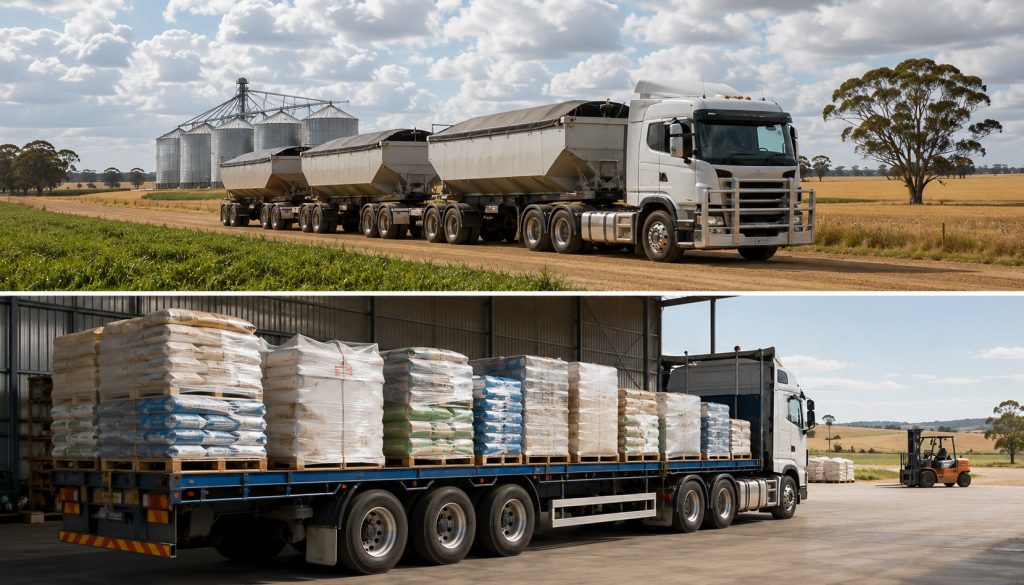
Seasonal demand can put considerable pressure on fertiliser transport, particularly when growers across the same region need palletised products within similar planting and application windows. Planning fertiliser transport early can help reduce delays, improve access to freight capacity and keep fertiliser arriving when it is actually needed on-farm.
Key Takeaways
- Fertiliser demand often increases around sowing, planting and other important application periods, creating concentrated demand for transport.
- Booking pallet transport early can provide more flexibility when freight capacity becomes tight.
- Accurate quantities, delivery details and timing requirements help transport providers plan loads and routes efficiently.
- Weather, road conditions, supplier availability and farm access can all affect delivery schedules.
- Coordinating fertiliser deliveries with spreading and other farm activities can reduce unnecessary handling and storage.
Why does seasonal demand affect fertiliser pallet transport?
Agriculture rarely operates according to a perfectly even calendar. Fertiliser requirements change throughout the year according to crop programs, soil conditions, rainfall, planting schedules and individual farm management decisions.
When conditions line up across a growing region, many farms can require fertiliser at roughly the same time. That concentration of orders has a flow-on effect throughout the supply chain.
Suppliers need products ready for dispatch. Transport operators need trucks, trailers and drivers available. Farms need suitable delivery access and somewhere appropriate to receive the load. A delay at one point can affect the next.
This becomes particularly relevant for palletised fertiliser because loads often need to move within relatively narrow application windows. A delivery that would be straightforward during a quieter month can require more coordination during a seasonal peak.
For growers, the practical lesson is simple: fertiliser availability is only one part of the equation. Freight availability needs to be considered at the same time.
When are the busiest periods for fertiliser transport?
There is no single peak fertiliser transport period that applies to every Australian farming operation. Timing varies according to region, crop, season and weather.
Demand commonly increases in the lead-up to major sowing or planting programs and during periods when conditions become suitable for fertiliser application. Rainfall can make the timing particularly dynamic. When useful rain arrives after a dry period, for example, growers may move quickly to take advantage of improved conditions.
That can create a sudden increase in freight requirements rather than a gradual rise in demand.
Different agricultural regions also work to different production calendars. For transport providers covering broad areas, seasonal planning therefore involves understanding where demand is likely to occur, what products need to move and when trucks are required.
Businesses moving several types of agricultural freight may also need to account for overlapping seasonal work. General freight transport requirements do not disappear simply because fertiliser demand has increased.
What causes delays during peak fertiliser transport periods?
Truck availability is important, but it is not the only factor that can affect a fertiliser delivery. Peak-season freight involves several moving parts, and small changes can quickly alter a schedule.
Common considerations include:
- Increased competition for trucks and drivers during agricultural peaks
- Fertiliser availability and loading times at the collection point
- Rainfall, flooding or unsuitable road conditions
- Changes to farm access following wet weather
- Incorrect delivery instructions or site information
- Limited unloading capacity when the truck reaches the property
- Last-minute changes to quantities or delivery dates
Some of these issues cannot be controlled. Weather is the obvious example. Others can often be managed through better communication between the grower, supplier and transport provider.
Providing accurate information from the start gives the freight operator a better opportunity to allocate suitable equipment and build an efficient delivery schedule.
How can growers prepare for peak fertiliser demand?
Early planning is one of the most useful ways to manage fertiliser transport seasonal demand. That does not necessarily mean every detail needs to be fixed months ahead. Farming conditions change too quickly for that.
It does mean discussing likely requirements before the busiest period begins.
Growers can estimate anticipated fertiliser volumes, likely delivery windows and preferred unloading locations. Even when final quantities are still being confirmed, advance notice gives the transport provider useful information for capacity planning.
It is also worth checking the practical details at the delivery point. Is there enough room for the truck to enter, turn and leave safely? Will unloading equipment be available? Are there access restrictions that the driver needs to know about?
These details can feel fairly minor until a truck arrives. During a busy freight period, though, an avoidable delay at one property can have consequences for deliveries scheduled later that day.
For larger agricultural requirements, discussing bulk freight transport alongside palletised freight may also help determine the most appropriate transport arrangement for the product and quantity involved.
Why does communication matter when seasonal conditions change?
A transport plan made several weeks ahead may need to change. Rain might arrive earlier than expected. A paddock may become inaccessible. Fertiliser might be required sooner, or an application program could be pushed back.
Good communication matters because freight schedules are interconnected.
When growers advise their transport provider about changes as early as possible, there is more opportunity to adjust truck allocation and delivery timing. Waiting until the scheduled delivery day leaves considerably less room to move.
The same applies to information from suppliers. Changes to product availability or collection timing can influence the entire delivery plan.
During peak periods, communication between all three parties helps reduce uncertainty. It will not eliminate every delay, but it can prevent a simple change in circumstances from becoming a larger logistical problem.
How should palletised fertiliser be planned differently from bulk freight?
Pallet transport has its own practical requirements. The number and weight of pallets, collection arrangements, unloading equipment and site access all need to be considered when organising the load.
Palletised products can offer useful flexibility for farms that need specific fertiliser products or quantities. They can also make storage and handling more manageable in some situations. But the delivery still needs to fit into the broader farm program.
Growers should consider where pallets will be placed on arrival and how quickly the fertiliser will be used. Appropriate storage is particularly important because fertiliser needs to be protected according to the manufacturer’s handling and storage requirements.
Where a business needs to move palletised fertiliser alongside other products, an experienced pallet transport and freight service can help coordinate the movement according to the characteristics of the load and destination.
The important point is not to treat the freight booking as an afterthought. Transport is part of the fertiliser supply process, not simply the final step.
How can fertiliser delivery be coordinated with spreading?
Getting fertiliser onto the farm is only useful if it fits the intended application program. A well-timed delivery should therefore consider what happens after the truck leaves.
Before confirming transport, it can help to check:
- When the fertiliser is expected to be applied
- Whether suitable unloading and handling equipment will be available
- Where pallets can be stored safely before use
- Whether weather conditions could change the spreading schedule
- Whether contractors, machinery and other resources have been coordinated
Where spreading forms part of the farm’s program, coordinating freight with fertiliser spreading services can help create a more connected process from supply through to application.
This becomes particularly useful during busy periods. There is little benefit in rushing fertiliser to a property if it then sits in an unsuitable location because spreading equipment will not be available for another week.
Equally, waiting until the spreading window has arrived before arranging freight can leave the farm exposed to peak-season capacity constraints.
Can weather make seasonal fertiliser freight demand harder to predict?
Yes. Weather is one of the reasons agricultural freight planning requires some flexibility.
Rain can influence when fertiliser is required, while heavy rainfall can simultaneously make transport more difficult. Local roads or farm access points may become unsuitable even though conditions in the paddock are moving towards an important application window.
Dry conditions can have the opposite effect. Growers may postpone planned applications, causing freight demand to fall or shift into a later period. If conditions then improve across a region, those postponed requirements can return at roughly the same time.
That is why seasonal fertiliser transport is rarely just about picking a date on a calendar.
A practical approach is to establish an expected delivery window, communicate likely changes and confirm arrangements as conditions become clearer. It gives everyone involved some visibility without pretending agricultural schedules never change.
Why is freight planning part of good fertiliser management?
Fertiliser decisions usually focus on product selection, rates, timing and application. Logistics deserves a place in that planning as well.
When freight is organised early, growers have more opportunity to coordinate supply with storage, labour, machinery and application schedules. It can also reduce the pressure of searching for transport when seasonal demand is already high.
This is especially relevant for farms ordering substantial quantities or receiving multiple deliveries. One delayed load might be manageable. Several poorly coordinated loads can create congestion, handling problems and interruptions to the broader farm program.
Good freight planning is not necessarily complicated. Often, it comes down to knowing roughly what is needed, communicating early and keeping the transport provider updated as the season develops.
How can McNaughts help plan seasonal fertiliser transport?
Seasonal fertiliser demand can change quickly, so transport arrangements need to combine forward planning with enough flexibility to respond to conditions on the ground.
McNaughts provides agricultural freight and related services, helping growers and agricultural businesses coordinate transport requirements across changing seasonal workloads. Planning ahead gives the team a clearer picture of expected volumes, destinations and delivery windows, while ongoing communication helps when weather or farm schedules change.
If you have upcoming palletised fertiliser requirements, it is worth discussing transport before peak demand arrives. Learn more about McNaughts or contact the team to discuss your freight requirements and upcoming delivery schedule.
